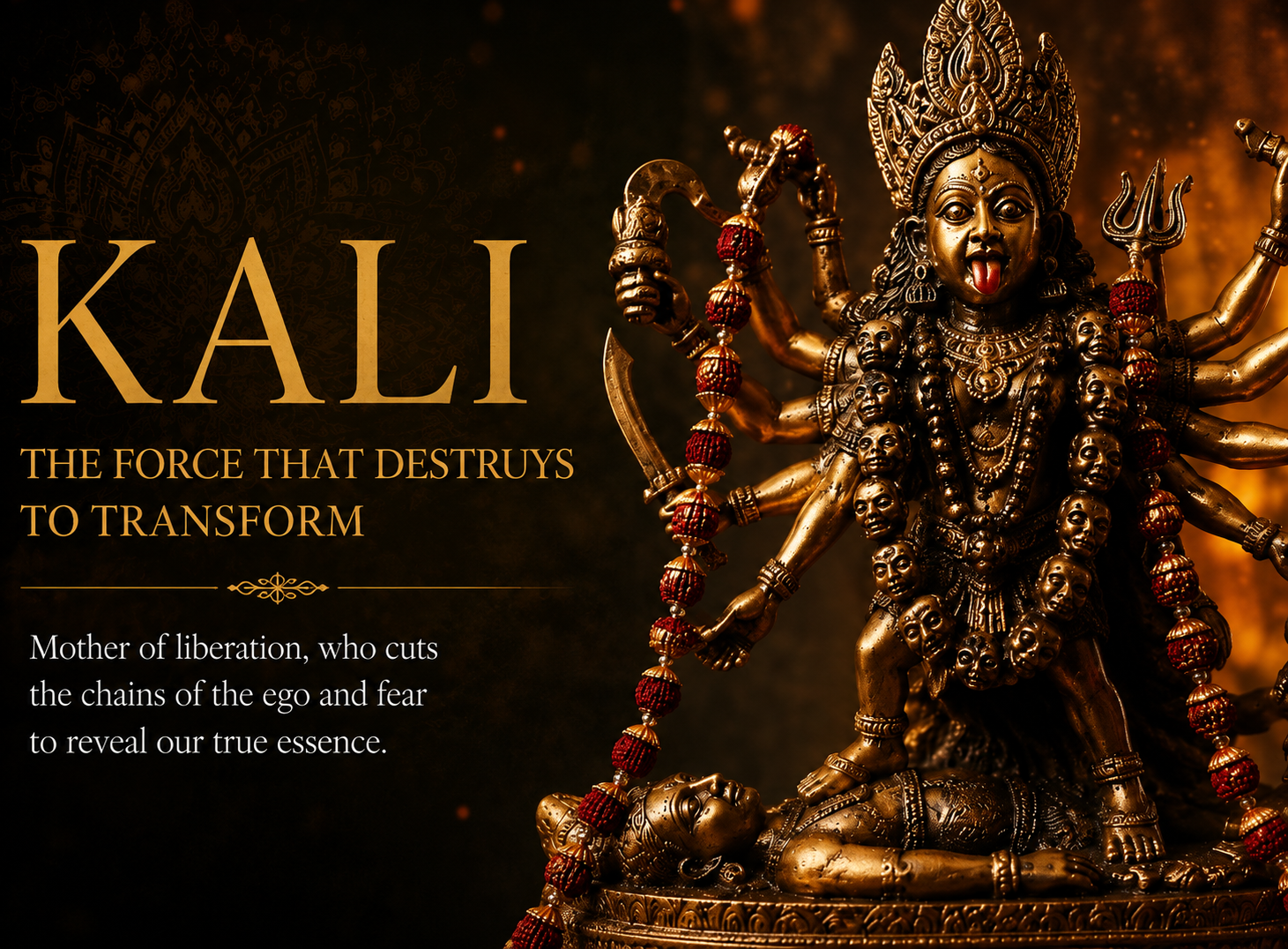
Kali. The force that destroys to create
There are figures that one buys for its beauty. others, because they arouse a curiosity difficult to explain. And some come to us without knowing that, over the years, they will end up revealing a much deeper meaning. this image of Kali, made in bronze, belongs to that last group.
I bought it in Pokhara (Nepal), a city located at the foot of the Himalayas, famous for the serenity of its Phewa lake and for being the gateway to the great mountain routes. However, beyond its landscape, Pokhara also preserves an intense spiritual tradition where Hindu and Buddhist temples coexist. It was there that I found this representation of Kali, which today is part of the Museum of Religions.
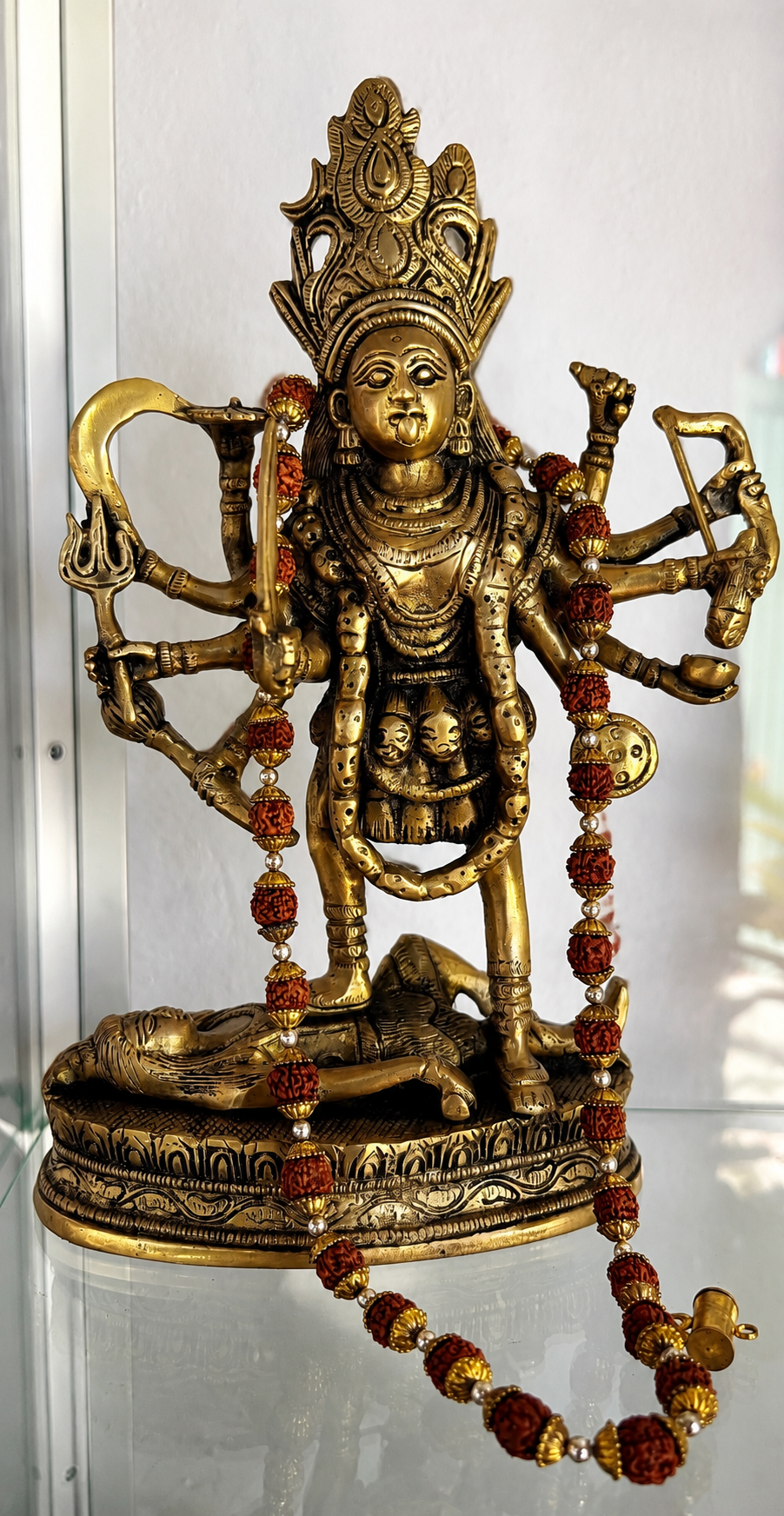
At first glance, Kali may be disconcerting. His tongue protrudes from his mouth, he holds weapons in his multiple arms, he wears a necklace of heads and appears standing on Shiva’s still body. For those who first approach Hinduism, the image may seem violent or even terrifying. However, its true meaning is exactly the opposite.
The mother who destroys the illusion
Kali does not represent evil. represents the true when it stops being comfortable.
Its name comes from the Sanskrit word Kala, which means time, but also that which inevitably puts an end to all things. Kali is the time consumed by the ego, false identities and everything we hold on to believing that it protects us.
In the Hindu tradition it is considered one of the most powerful manifestations of Shakti, the creative energy of the universe. When demons symbolize ignorance, pride, or attachment, Kali appears to destroy them.
It doesn’t destroy life.
It destroys what prevents us from living fully.
Why does he stick out his tongue?
One of Kali’s best known traits is her extended tongue.
There are several interpretations. One of the most widespread tells that, during a battle against demons, Kali entered a state of such intensity that she began to destroy everything she found in her path. Only when he accidentally stepped on Shiva’s body became aware of his overflowing force and, ashamed, stuck out his tongue.
Another interpretation considers that the language represents the devouring power of time, which ends up absorbing everything.
As with so many Hindu symbols, both readings can coexist.
Shiva under his feet
Perhaps the most surprising detail of this sculpture is the figure on which Kali stands.
It is not an enemy.
It is Shiva.
Far from expressing domination, this image symbolizes that energy (Shakti) needs a conscience that sustains it, and that the conscience (Shiva) remains immobile without the energy that sets it in motion.
It is one of the deepest representations of the complementarity between both principles.
Kali's weapons
Each of his arms holds a different object.
The sword cuts ignorance.
The trident symbolizes dominance over creation, conservation and destruction.
The other weapons represent the different ways in which consciousness overcomes fear and attachment.
They are not weapons to destroy people.
They are instruments to overcome what enslaves us internally.
the head necklace
One of the symbols that most impresses is the necklace made up of human heads.
It does not represent a victory over other beings.
Each head symbolizes an ego aspect, an identification, an illusion, or a limitation that must die in order for a freer consciousness to emerge.
In many traditional representations it also refers to the letters of the Sanskrit alphabet, reminding us that even language and concepts have limits when we try to understand ultimate reality.
Kali and Psychology
From a psychological perspective, Kali represents something we all experience at some point.
There are times when life destroys the identity that we thought we were: a loss, a disease, a break or a trauma, that what we identified with would cease to exist.
Our initial reaction is usually to resist us.
However, many times it is precisely that destruction that allows building a more authentic identity.
In the Parcuve model, we could say that Kali symbolizes the moment in which defensive structures stop holding us. It’s painful, even scary, but it can also be the beginning of a deep transformation.
Because we don’t always suffer for what changes.
We often suffer because we try to preserve what should already be over.
An invitation to look beyond
This bronze sculpture, acquired in Pokhara, reminds me that many of the religious images that we contemplate today with strangeness were created to convey deep teachings about human nature.
Kali does not invite us to fear destruction.
It invites us to ask ourselves what part of us needs to disappear so that something truer can be born.
Perhaps that is the most current message of this ancient goddess: Not all destruction is a loss; Some are the first step towards freedom.
There are objects that one finds by chance and others that seem to be waiting for us.
this oil of Kali I bought it at Thamel, the heart of Kathmandu. It was not an impulsive purchase. For several days I walked through its narrow streets, entering small galleries, craft shops and traditional painting workshops. He had seen many depictions of Kali, but none of them managed to convey the force he was looking for. until this one appeared.
Since then he has been part of museum of religions.
Every time someone contemplates it, the same reaction usually occurs: fascination mixed with restlessness. His tongue protrudes from his mouth, he holds weapons in his multiple arms, he wears a necklace of heads and rises above Shiva’s body. For those who do not know Hindu symbolism, it is a disturbing image.
And yet few religious figures have been so misunderstood.
The death that Kali represents
Kali is not the goddess of violence.
She is the goddess of transformation.
His name comes from Kala, time, that force that ends up destroying everything that we believe is permanent.
Destroy pride.
Destroy attachment.
Destroy false identities.
Destroy the ego.
That is why it appears covered with cut heads. They do not represent defeated people, but the multiple masks we live with believing that we are someone other than our true nature.
The sword he holds is not directed against the others.
It is directed against our illusions.
The sacrifice that we are all called to perform
Perhaps the biggest mistake has been literally interpreting what was always a powerful symbol.
The true sacrifice that Kali proposes does not consist in offering the life of another being.
It consists of sacrificing what keeps us slaves.
our fears.
our need to control.
the identities we build to survive.
From psychology, we could say that Kali represents that moment in which defensive structures stop sustaining us. What for years protected us ends up becoming a prison.
In the Parcuve model We understand that identity is not something fixed, but an emotional construction born of our attachment history and traumatic experiences. When that identity ceases to be functional, change is usually lived as a death.
And, in a way, it is.
Because for a new way of being in the world to be born, the old one must die before.
A deeply current goddess
Perhaps that is why Kali remains one of the most powerful images of Hinduism.
It reminds us that growing up means losing.
that all transformation requires giving up something.
That suffering does not always come from change, but from desperate attempt to preserve what has already fulfilled its function.
After going through the streets of the Thamel for days, looking for this painting, I understood that I was not buying only one work of art.
He was carrying with me a symbol that summarizes one of the great teachings of the East.
True evolution does not begin when we change the world around us, but when we are capable of sacrificing the identity with which we have spent all life identifying ourselves.
Perhaps that is why Kali continues to look at us with the same intensity for centuries.
Not to inspire fear.
but to ask us:
What part of you needs to die so you can become who you really are?
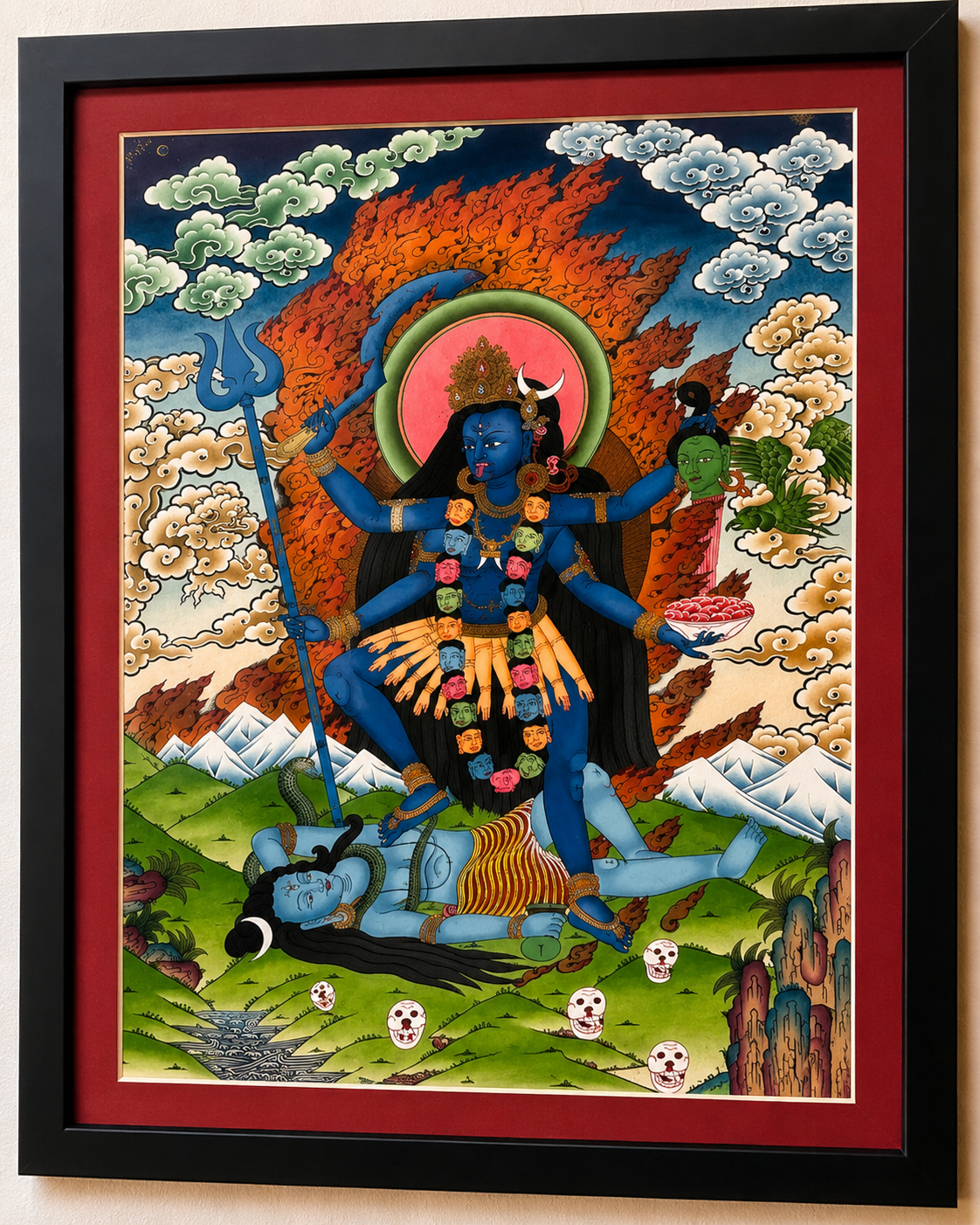
The Black Legend of Kali
During my first trip to India in the 1990s, I heard numerous stories about Kali. In Calcutta they told me of ancient sacrifices made in his honor. Years later I discovered that many of those narratives mixed historical events, popular legends and the vision that the British chroniclers spread during colonial times.
Joseph Campbell recalls in some of his works that even in the 19th century there were stories about human sacrifices associated with certain Kali cults. Today we know that, if they really happened, they were very exceptional practices, linked to specific groups and far from what Hinduism represented as a whole.
What has lasted to this day in some temples in Nepal and certain regions of India are the ritual sacrifices of animals, especially goats or buffaloes, although they are more and more discussed and many places have replaced them with symbolic offerings.
These practices have contributed to building the image of Kali as a bloodthirsty goddess.
But that interpretation barely touches the surface of its true meaning.
It does not mean destroying our instincts, but learning to integrate them without governing our lives.
Piece of the Museum of Religions
Title: Kali
Origin: Kathmandu (Thamel), Nepal
Religion: Hinduism
Main Meaning: Kali is one of the most powerful manifestations of Shakti, the creative and transforming energy of the universe. Its iconography, with multiple arms, weapons, a necklace of heads and extended tongue, symbolizes the destruction of the ego, ignorance and attachment. Although historically some cults associated with Kali made ritual sacrifices of animals and there are references to ancient human sacrifices in certain tantric contexts, their deepest meaning is spiritual: the true sacrifice is that of false identities that prevent us from achieving inner freedom. Kali represents the transformation, the symbolic death of the ego and the rebirth of a more authentic consciousness.
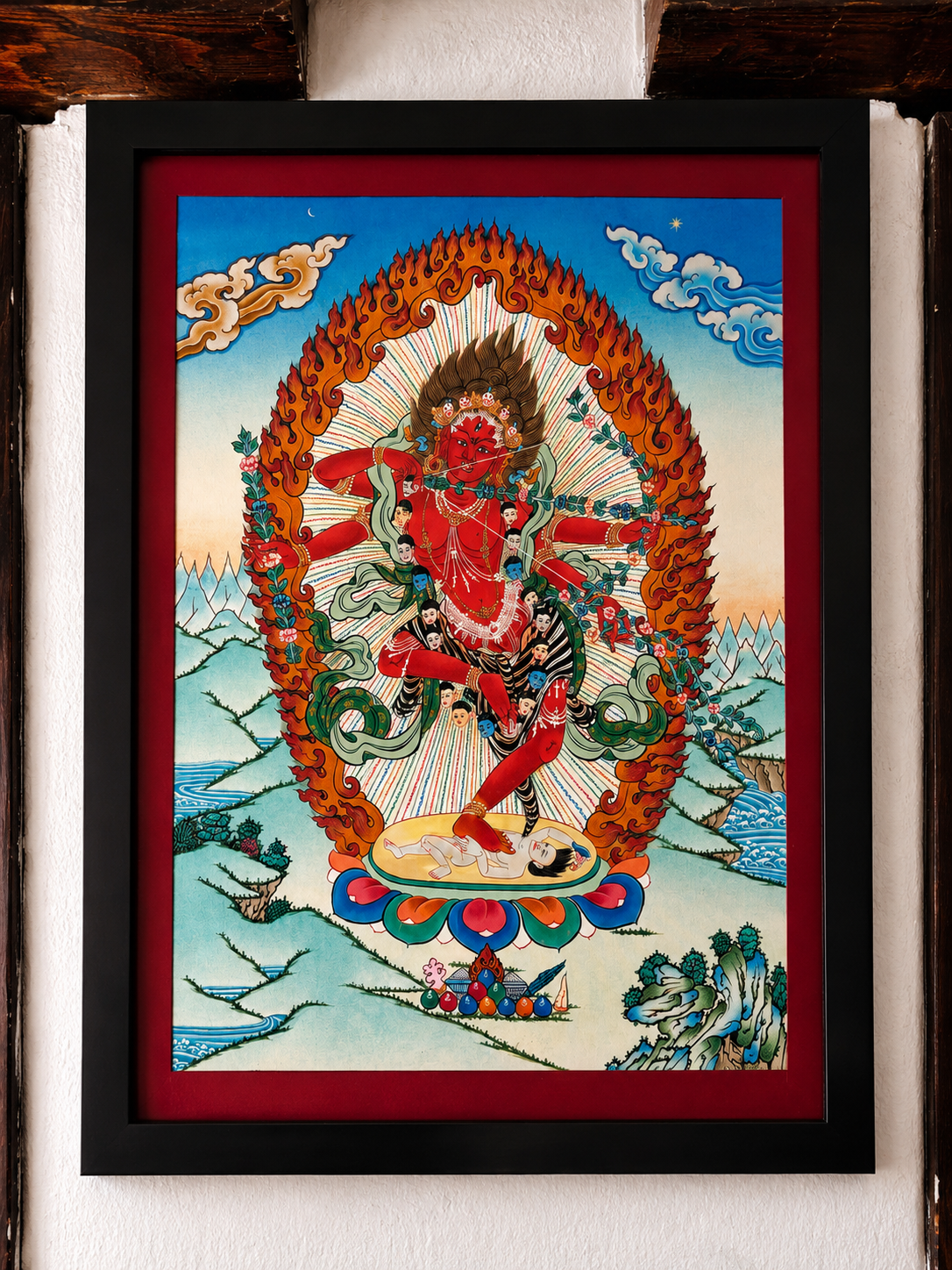
This painting represents one of the angry deities of Tantric Buddhism and, for me, it is much more than a religious image. It is a magnificent example of something that has always fascinated me: to see how religions do not appear out of nowhere, but evolve, dialogue with each other and continually transform.
Perhaps one of the greatest teachings that has allowed me to go through so many countries and visiting so many temples is to discover that the borders between religions are much more diffuse than we usually imagine. Behind the names, the rituals or the images, the same symbols appear again and again, reinterpreted by different cultures.
Joseph Campbell dedicated a good part of his life to showing us precisely that: that myths are a universal language that adopts different forms according to the people who transmit them. Since I read his works, an important part of my travels has been looking for those invisible threads that unite some traditions with others.
Tibetan Buddhism is one of the most extraordinary examples of this process of syncretism. He was born in India from Mahāyāna Buddhism, incorporated numerous elements of Tantric Hinduism—especially Shivaism and Shakti worship—and, upon arriving in Tibet, he spoke for centuries with the ancient Religion Bon, integrating part of its symbols, its protectors and its ritual universe.
For this reason, many of his deities retain an appearance reminiscent of Kali, Mahākāla, or other Hindu divinities. However, Buddhism gave them a new meaning. Anger stopped representing a destructive force to become the energy that destroys ignorance. The enemy is no longer outside, but within us.
I believe that this process is not an exception, but a constant in the history of religions. The more I travel, the more convinced I am that all spiritual traditions have learned from each other. None has come up completely isolated. All have inherited symbols, transformed stories and adapted old beliefs to new ways of understanding the world.
Perhaps that is one of the reasons why I keep traveling and collecting these pieces. I’m not just looking for old objects. I look for the invisible connections that remind us that, behind the immense religious diversity, humanity has been asking the same questions for thousands of years and trying to answer them through different symbols.
Lorem Ipsum pain sit amet, adipiscing elit. ut elit tellus, luctus nec ullamcorper mattis, pulvinar dapibus leo.