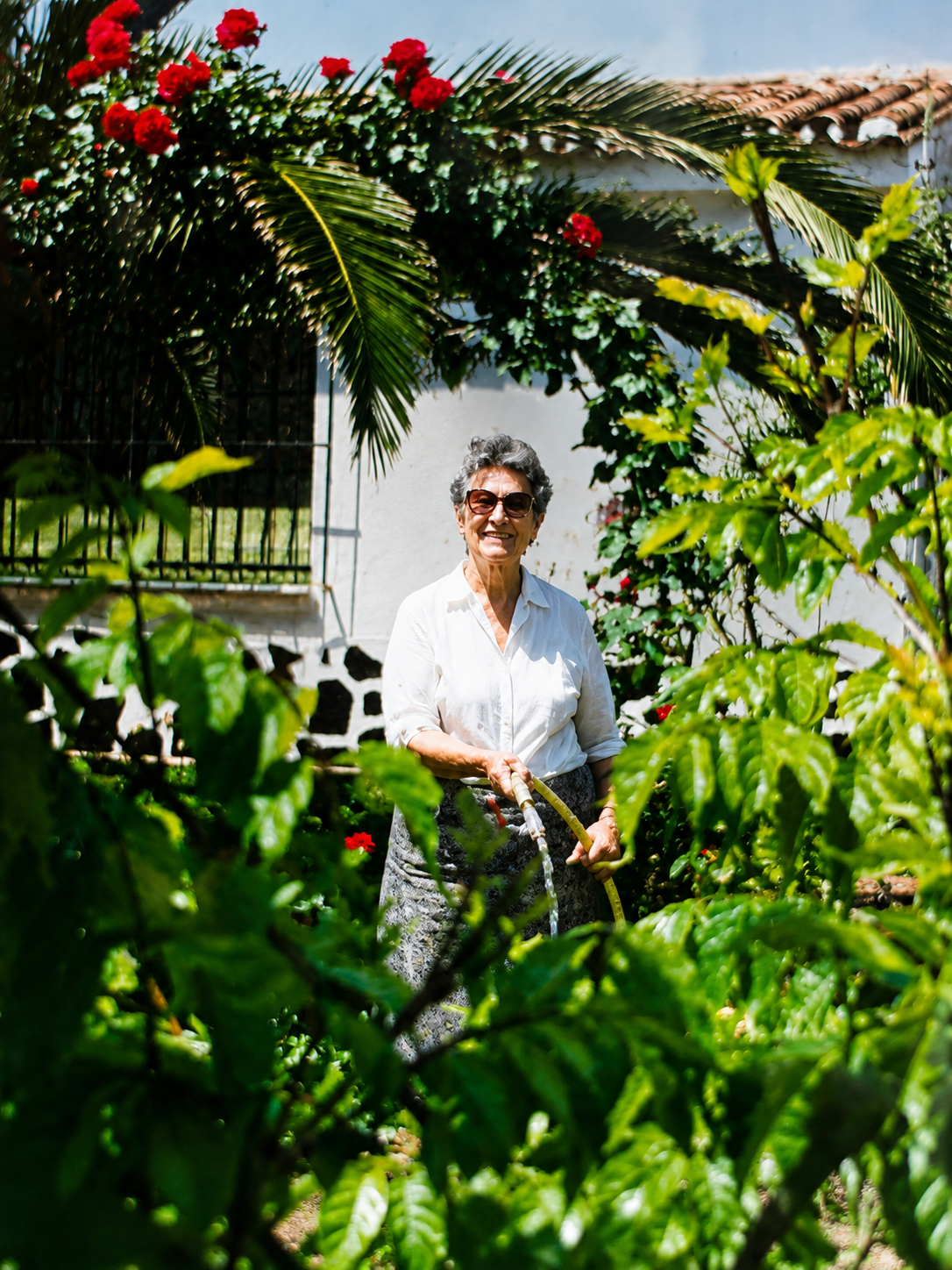
My grandmother, a rosary, and time standing still
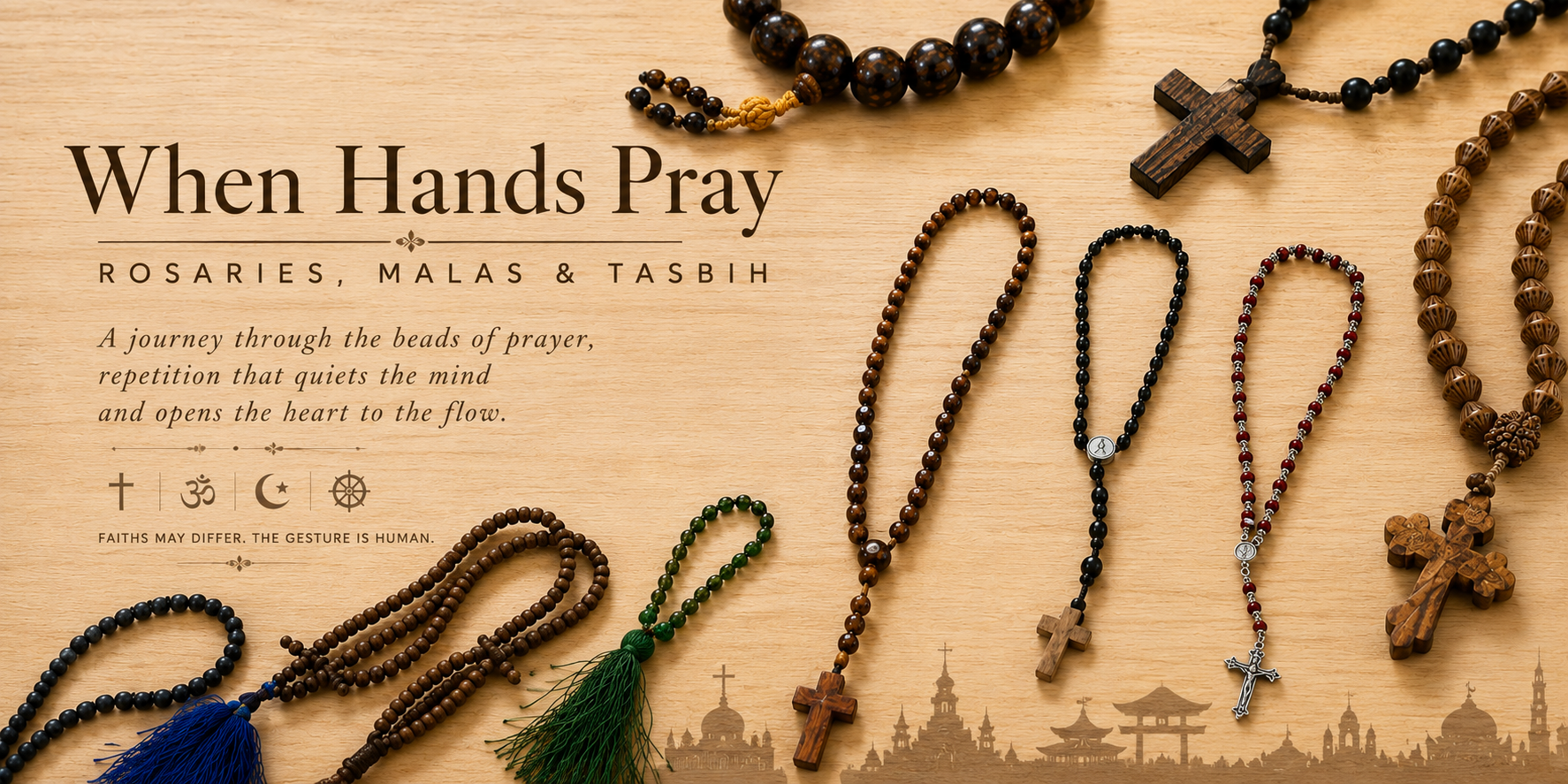
One of my childhood memories is of my grandmother and her sister praying the rosary together every afternoon. They would sit side by side and repeat the prayers, following the rhythm of the beads. Back then, I didn't fully understand the meaning of that daily gesture. Over the years, I've come to think that, besides being a religious practice, it was also their way of connecting, of supporting each other, and of entering a state of calm together. While one recited the first part of the Hail Mary, the other responded. The familiar words, repeated hundreds of times, no longer needed to be thought about. The movement of their fingers on the beads, the cadence of their voices, and the succession of prayers created a kind of shared flow. During that time, the worries of the day seemed to be suspended, and they both inhabited a different space: intimate, predictable, and sacred. Repetitive recitation appears in many religious traditions. It doesn't aim to contribute a new idea with each phrase. Its function is different: to give rhythm to the mind, reduce inner noise, and foster sustained attention. When a prayer or mantra is repeated, the words cease to function solely through their meaning. They also become sound, breath, and movement. The person doesn't have to decide what the next word will be or where to direct their thoughts. They simply continue. And in this continuity, a sensation akin to flow can arise: the awareness of time diminishes, the internal dialogue quiets, and attention is absorbed by the gesture. To facilitate this practice, very different religions have created similar objects: rosaries, malas, tasbihs, prayer cords, and beaded bracelets. The names, materials, and number of beads vary, but all allow the hands to accompany the mind. In Christianity, the rosary mandates the repetition of the Lord's Prayer, the Hail Mary, and other prayers while contemplating scenes from the lives of Jesus and Mary. The cross marks the beginning of a journey that is simultaneously verbal, tactile, and symbolic. In Hinduism and Buddhism, the mala typically has 108 beads and is used to repeat mantras or sacred names. Each bead allows one to return to the practice when the mind wanders. Some malas are made of wood, stone, or rudraksha seeds, which are especially associated with Shiva. In Islam, the tasbih or misbaha is usually made up of 33 or 99 beads, related to the names and attributes of God.
It is used in dhikr, the practice of remembrance, through the repetition of formulas of praise and glorification. There are also Eastern Christian rosaries made with knots, wooden beads, seeds, bone, glass, or other common materials. Some are delicate pieces; others are humble objects, worn smooth by the constant rubbing of fingers. All of them transform something invisible—prayer, attention, remembrance—into a physical movement. The beads do not contain the religious experience, but they help sustain it. They mark the rhythm, gather distractions, and allow one to return again and again. Now, looking at these objects in my collection, I think again of my grandmother and her sister. Perhaps praying together was not merely repeating prayers learned as children. It was their way of synchronizing themselves, of caring for one another, and of entering each evening into a small shared space. Different religions, different words, and different names for the sacred, but the same gesture: passing the beads between their fingers until the repetition transforms into presence.
The Art of Devotion: Tasbih in Islam
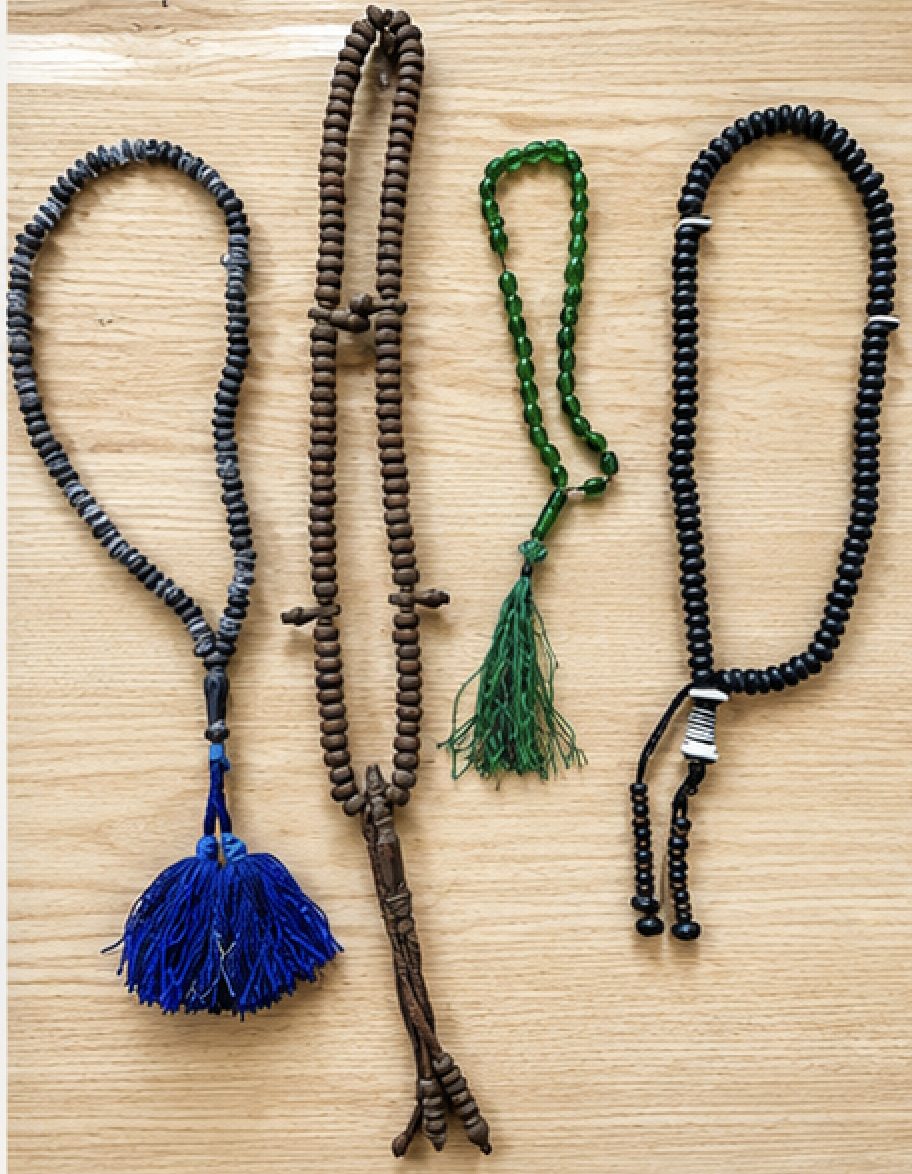
The tasbih or misbaha is one of the most universal devotional tools in the Islamic faith, designed for the practice of dhikr (the remembrance and rhythmic invocation of God). Although its use visually evokes the Christian rosary or the Buddhist and Hindu mala, its structure and symbolism reflect a profound theology of its own. [1, 2, 3, 4] Typically structured with 99 beads (representing the 99 names or attributes of Allah) or 33 beads (designed to be wound around three times), these objects not only mark a mathematical count but also a path of spiritual concentration. Through them, the believer repeats formulas of praise such as Subhan Allah (Glory to God), Alhamdulillah (Praise be to God), and Allahu Akbar (God is the Greatest). [1, 2, 3, 4] Variety of Materials and Visual Symbolism: The collection displayed in this case illustrates the rich aesthetic, geographical, and material diversity of these prayer instruments: Noble Woods and Sufi Identity: Examples carved from dense natural woods (such as ebony or tamarind) are especially valued in various mystical brotherhoods or orders (tariqas). In some traditions, such as the Tijaniyyah, the beads adopt very specific configurations and additional counters for their daily litanies. [1, 2, 3] The Color Green: The tasbih of translucent green beads stands out for its symbolic significance. Green is considered the sacred color of Islam, associated in Quranic texts with vegetation, life, and paradise. Organic Materials and Resins: From the use of carved bone to resins and minerals, each piece reflects the geography and resources of the region where it was made, uniting local folk art with the omnipresent spiritual liturgy of the global Muslim community (Ummah). The tasbih transcends the strictly liturgical sphere: it is an everyday companion, a protective amulet in homes or vehicles, and a tactile testament to the unbroken bond between the believer and the divine. [1, 2, 3]
The Echo of the Mantra: The Japa Mala in Hinduism and Buddhism
The mala (or japa mala) is the sacred string of beads used in Dharmic traditions—primarily Hinduism, Buddhism, and Sikhism—for meditation and mantra counting (japa). Beyond being a physical counter, it acts as a visual and tactile anchor that helps calm the mind, focus intention, and channel spiritual energy during devotional practice.
The traditional structure of a mala consists of 108 beads. This sacred number holds profound cosmic connections: it represents the relative distance between the Sun, the Moon, and the Earth; the 108 energy lines that converge to form the heart chakra; and the 108 human passions that the practitioner seeks to overcome. In addition, it includes a larger central bead called Guru or Meru, which is not counted but marks the beginning and end of the meditation cycle as a symbol of respect for the teacher or the divine.
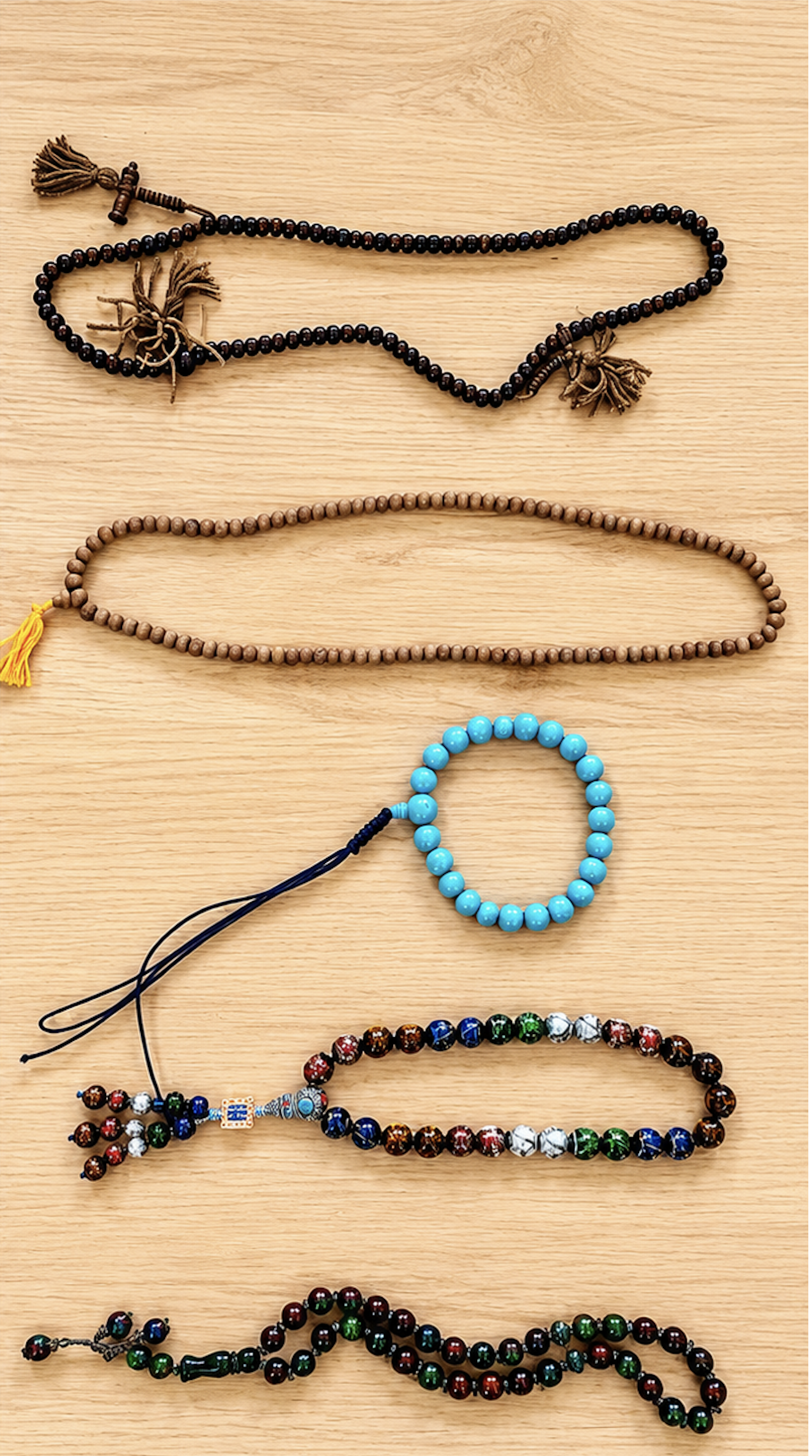
Materiality, Aesthetics, and Spiritual CurrentsThe selection on display shows how the materials and colors of malas are meticulously chosen according to the deity venerated, the type of practice, or the school of thought: Seeds and Sacred Woods: Necklaces made of light wood (such as sandalwood) or sacred basil seeds (tulsi) are pillars of Vaishnavism, providing a calming aroma. On the other hand, dense, dark woods evoke the detachment and introspection characteristic of ascetic practices and deep meditation. Semiprecious Stones and Turquoise:
The use of translucent or opaque minerals, such as turquoise or lapis lazuli, is very characteristic of Tibetan Buddhism and Tantrism. These materials are associated with healing, spiritual protection, and the activation of specific energy centers (chakras). Polychrome Beads and Ornamentation: The examples with multicolored decorated beads, ornate metal spacers, and detailed tassels reflect the rich artistic heritage of the Himalayan regions (Tibet, Nepal, and northern India).
Each color and spacer bead helps the practitioner mentally subdivide their meditation. By rhythmically and continuously passing each bead, the practitioner not only accumulates repetitions of a mantra but also symbolically and progressively advances on their path toward spiritual awakening and inner peace.
Each object has its own story.
The first malas are from India, Tibet, Nepal, China, or Japan. While all are Buddhist, each one also varies depending on its origin. Therefore, they are different pieces, colors, lengths, etc.
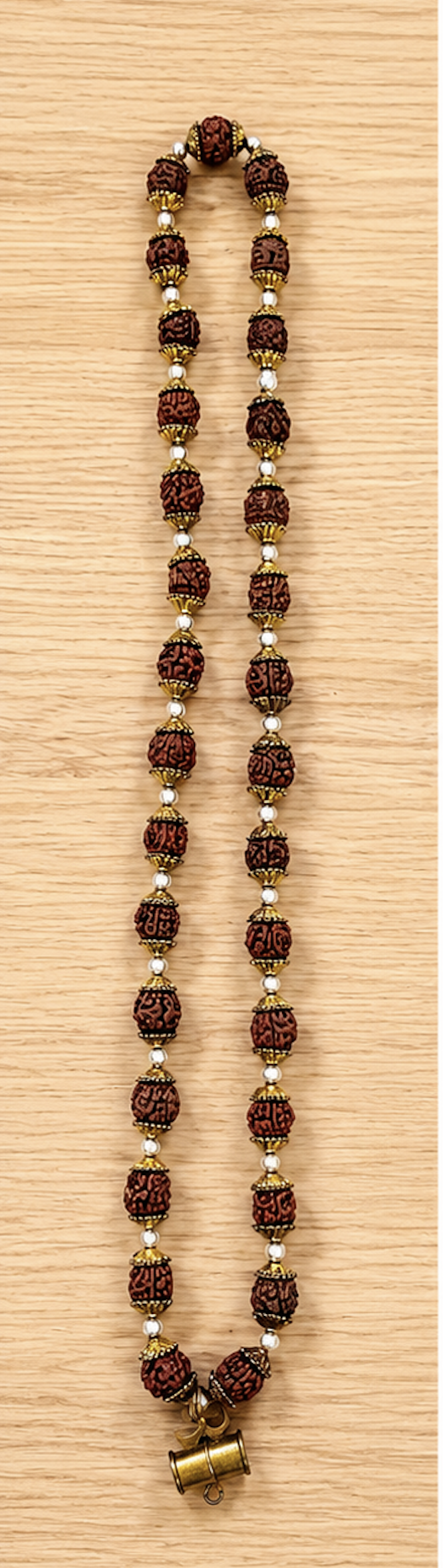
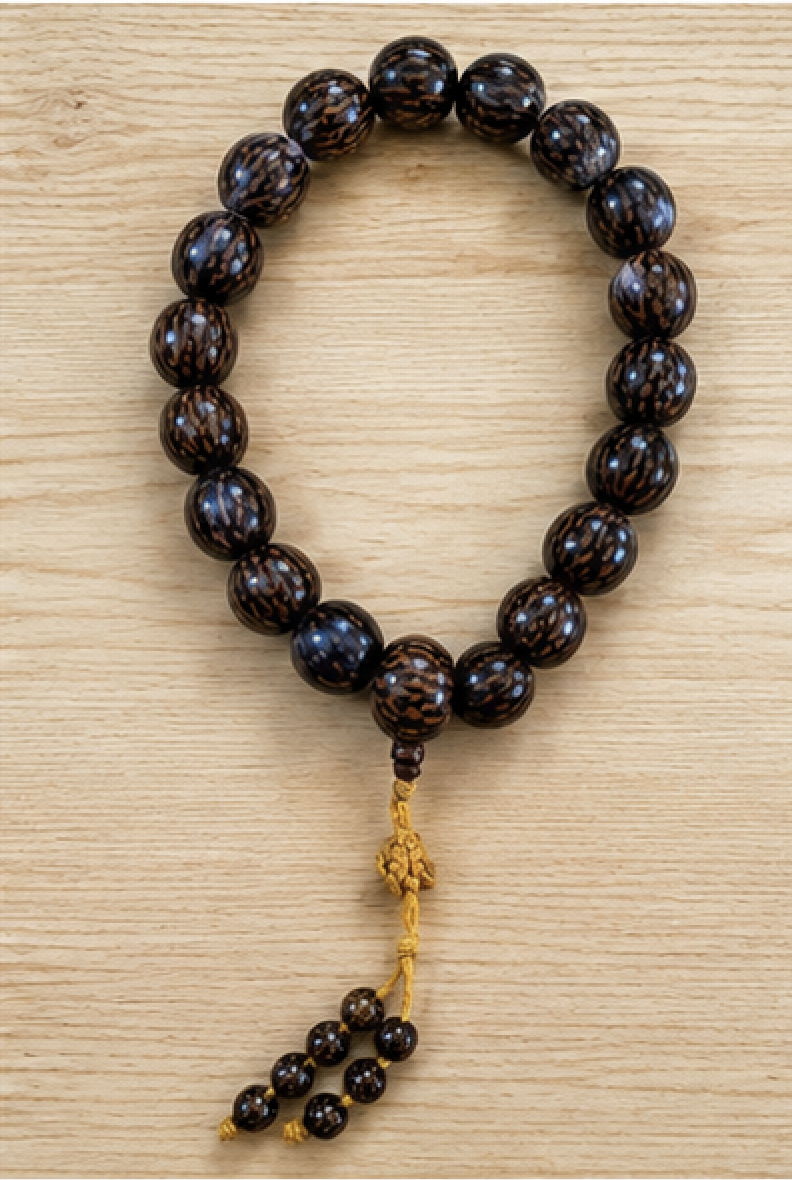
The second piece is Hindu, and I bought it in Pokhara. It is made of Rudra seeds, one of the symbols of Shiva.
The third piece is a Taoist mala that I bought when I climbed the Hua Shan mountains in China; the beads are very thick and come in many sizes.
The Heartbeat of Prayer: The Rosary in Christianity
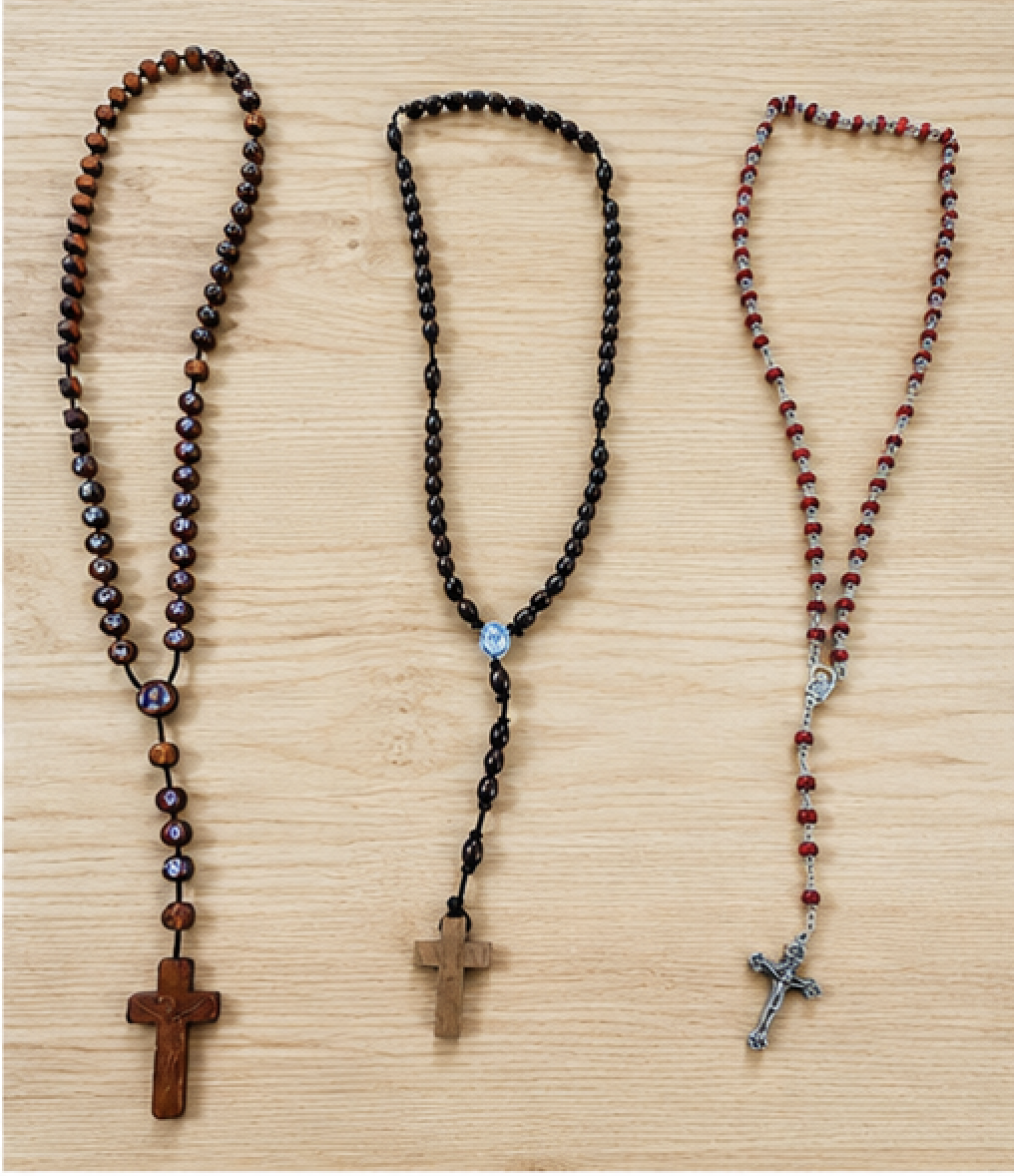
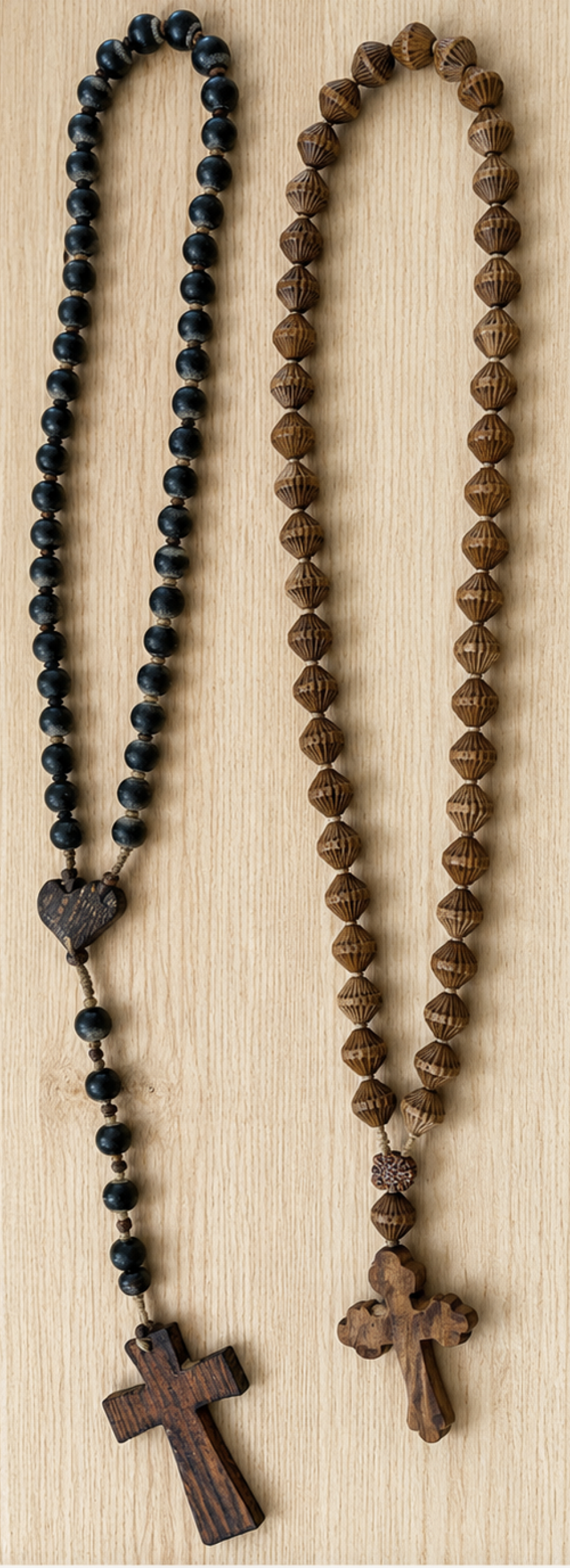
The rosary (from the Latin rosarium, "rose garden") is one of the most deeply rooted devotional objects in the Catholic tradition. Its use combines vocal prayer with contemplative meditation on the "mysteries" of the life, death, and resurrection of Jesus Christ and the Virgin Mary. Each bead acts as a physical and rhythmic step that guides the faithful, allowing them to detach from their surroundings to connect with the sacred. A traditional rosary consists of 50 small beads arranged in five decades (for the Hail Marys), separated by larger beads or spacers (for the Our Fathers). The rosary converges on a central medal and ends with a cross, the ultimate symbol of the Christian faith. Local Identities: From Intimacy to Monumental Scale. This section of the museum juxtaposes two physical and cultural dimensions of the same spiritual practice, displaying pieces from Spain and Egypt.Hand Rosaries (Everyday Use): The standard-sized examples on display are designed for personal, domestic, or liturgical use. Crafted with carved hardwood beads, dark resins, and simple crucifixes (both wooden and metal), they reflect the sobriety and intimacy of daily prayer in Spanish homes and global Christian communities.Monumental Rosaries (The 1.5-meter model): In contrast to individual beads, the large rosaries, 1.5 meters in length, are linked to public, communal, and monumental devotion. The Heritage in Spain: Historically, these large rosaries are associated with the "Rosarios de la Aurora" (dawn processions), penitential brotherhoods, or as votive offerings hung on altars, chapels, and monastery walls.The Connection in Egypt: In the Egyptian context, the Coptic Christian tradition has its own counting practices and iconography (frequently using crosses without the figure of the recumbent Christ). Large-format rosaries in the Near East are often manufactured using local textured woods or stones from the region, serving as powerful visual symbols of protection and communal faith within sacred spaces.